
 Clique aqui para ler esse post em português
Professional transitions many times happen as a result of our own choices, but they can also be provoked by external factors, things out of our control. In this last category, one of the changes that are more traumatic and difficult to grasp, is the one that happens as a result of a dismissal. A few months ago, I started a partnership with an executive who had his (10 year) career in a multinational company, abruptly interrupted. He had a very practical objective for our sessions: he wanted to start a brand new career, build a new professional identity and define a clear plan on how to ‘get there’. When we started exploring the present moment, it was evident that there were some important ‘internal obstacles’ for the change. The pain for ‘the loss’ had not yet been processed and there was a great risk that these emotions could sabotage the objectives he was trying to achieve.
I proposed that we explored the situation with a broader perspective, that we looked at the ‘big picture’. To do that, one of the tools that I find really useful is the Bridges Model of Change (image below). The concept it presents is simple, almost obvious, and perhaps for this reason, it triggers valuable reflections for people going through such transitions.
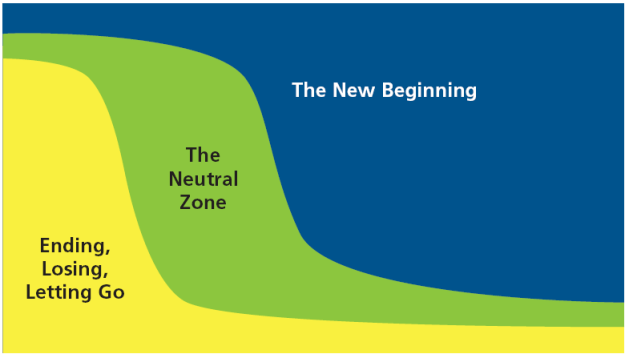
The yellow area in the image above represents the ‘Ending Phase‘, that is that period in which we disengage from the old identity and ways of working and acknowledge what was or will be lost. There is always something that gets lost, isn’t it? It was exactly this phase that my client was trying to avoid. He wanted to rapidly jump into the ‘New Beginning‘ (blue area) and was hesitating to face his emotions, believing that if he ignored them, they would disappear. Actually, he didn’t allow himself to feel ‘the feelings’, he thought it was a sign of weakness.
With the help of this model, we alternated the ‘practical’ discussions (i.e. review actions and plans for the future) with conversations about the emotions that had been generated by the job loss. We talked about how these feelings were impacting his capacity to move confidently towards his ‘New Beginning’ and how to deal with these emotions. An important part of our work was to spend time exploring the ‘Neutral Zone‘ (the green area in the centre) that is the period when we are not yet totally ‘disengaged’ from the past and the new is yet to be fully known and/or implemented. It is really beneficial to understand that this is a necessary phase and that is natural to feel a bit disoriented and without a clear sense of direction.
The work of a Transition Partner is, among other things, to point out to the opportunities that arise when one crosses the Neutral Zone. Yes, this is a moment to plan and deal with the practical aspects that will lead people to the future. But is it also a moment for reflection. It is a time to celebrate the past victories, to accept the losses and to explore with greater awareness the alternatives for the ‘New Beginning’. This is the moment to ‘create’ this new future in a way that is totally aligned with own values and purpose.
To help transform the potential discomfort and confusion of the Neutral Zone into a period of discoveries and alignment with personal values is one of the good things of my work as a Transition Partner. It is rewarding to see that my client is now more aware of the things that were holding him back and due to this awareness, he has the control to make better choices. He is now moving steadily towards his new career, his new beginning.
Click here to know more about My Services and how I can help professionals to make the best of their transition. I wish a great and productive week to all!
 Luciana Biscaia