Category Archives: Expats

Human stories

1280px-Flag_of_Brazil.svg Clique aqui para ler esse post em português

Today, the post is short. In fact, the focus today is just to recommend a very cool documentary that will appeal to all people who are (as well as I am) interested in the richness of cultural differences and also by the things that unite us all, humans. Empathy is a buzzword nowadays and it is, undoubtedly, a much needed skill to navigate the current challenges of our planet. I truly believe that besides concepts and academic theories on the topic, it is art a great source of learning and inspiration for us to live a richer and more harmonic life.

Screenshot 2016-06-14 18.32.13

Human, the movie, launched in September 2015, is a collection of stories and images that translate ‘what it means to be human’. The stories are of common people. Stories of love, hate, despair and also of hope. Stories that show our dark side and what is most noble in us. Above everything, the movie talks about the things that are universal and it lead us to reflect about ourselves and the world we live in.

The movie was produced in a period of 3 years and more than 2,000 people in 60 countries were interviewed.  There are 3 ‘volumes’ or 3 collections of interviews and each volume lasts for about 1 hour. All of them are available (for free) in YouTube. The link follows below.

https://www.youtube.com/results?search_query=human+the+movie

I hope you like it and feel inspired too.

Diversity, bias and the points system.

1280px-Flag_of_Brazil.svg Clique aqui para ler esse post em português

One of the reasons I left Brazil to work in London were the new guidelines defined by the Group CEO. He wanted representatives from the countries where the company operated working in the Head Office. What a great idea, isn’t it? Interviews were conducted and a few ‘foreigners’ were selected to join the central team. The principle, broadly accepted, was that a more diverse workforce would promote understanding of the various perspectives, increase integration of the global teams and, in turn, generate more profit to the business. It made sense to do it. Well, at least, in theory.

In practice, things happened to be a little bit more complex. Even though I was excited with the possibility of ‘exchanging views & sharing experiences’, I quickly noticed that ‘getting to know my culture‘ and benefiting from my ‘diverse perspective‘  were not things most people were particularly interested in. It was also surprising to see that some members of the local team nurtured stereotypical ideas about who I was and how I behaved. It was the first time in my life/career that I had to clarify things such as:  “Yes, I am very punctual” or “No, I am not happy all the time and I definitely don’t dance Salsa!”.

There was a lot of talk about embracing global diversity in the Head Office, but as the organisational culture was predominantly local, the day-to-day attitudes frequently conflicted with the ‘talk’. There was a subtle pressure for standardisation. And the standard, of course, was the culture of the majority. The sooner the ‘different’ started to behave as ‘a local’ the better.  It felt like an orchestra where everybody had to play the same instrument. With so many different ‘tunes‘ available, it felt like a complete waste. When getting updates on the initiative, the CEO would certainly see an increase in the percentage of ‘diverse people’ in the Head Office, but in practice, very little was changing.

As I was not yet known by the group, I was in a constant ‘battle’ to get people to pay attention to what I had to say. I knew my inputs were relevant so I concluded that the issue was of a different kind. After having my observations politely ignored  whilst some other perspectives were applauded (even when they were less than coherent), I imagined that bias should be fuelling a kind of invisible ‘points system‘. It goes like this: when a person arrived in a meeting, the other participants would use their (conscious or unconscious) bias in relation to gender, cultural background, hierarchy etc. to award points. Depending on the amount of positive or negative ‘points’ granted to a person it would be more (or less) likely that s/he would get own inputs considered or accepted by the group. i.e. ideas coming from people with many negative points would be discarded in no time. As for me, it felt I was losing two points for being a woman and other two for being Latin American. At least I knew I had to fight four times harder to be heard! I shared the concept of the ‘points system’ with other expats and many of them reported having experienced something similar. One thing to mention is that the literature on unconscious/conscious gender bias is vast but not much have been written about cultural bias. My view is that this is a big area of opportunity.

On time (and with the help of a coach) I managed to understand and adapt to my new environment, created good relationships and felt more included. I definitely learned a lot. Later on I met amazing people who showed me that with good leadership bias can be managed and that merit and competence are the only criteria to ‘award points’ to professionals. It was also in this period that I started to get interested on cross-cultural relationships and the factors that contribute (or block) the adaptation of expatriates. Today I am convinced that the expat adaptation can be optimised with the previous preparation, not only of expats, but also of the local teams. Having open conversations about stereotypes and ‘unconscious bias’ is a good starting point. There are many initiatives addressing the issue nowadays and a good example is a course on Unconscious Bias recently delivered to Facebook employees.  I found it very pragmatic, dynamic and informative, although with a lot more focus on gender bias.  I recommend it to anyone interested on the topic. Here you go the link : https://managingbias.fb.com

And…if you want to know more about how the work with a Transition Partner can support the adaptation of expats, do get in touch.

Have a great week! See you next Tuesday.

Latin Americans in the World

1280px-Flag_of_Brazil.svg Clique aqui para ler esse post em português

Moving to a new country is one of the most ‘intense’ and full of opportunities (and risks) transitions. To become an expat is the goal of many profissionals who see in this experience the opportunity of widening horizons, ‘supercharge’ their development and multicultural skills. I know about this subject well, as I am an expat myself and have been in this path for the last 10 years. In the page About Me, you will find more information about my career outside my ‘motherland’.

Since the first months of my life abroad I became intrigued about the multicultural dynamics  in the workplace and started to observe and analyse the elements that supported (or blocked) the professional success of expats. My work as a Transition Partner is one of the outcomes of this study. My experience and observations enable me to support other expats in making sense of their new context, manage emotions and behaviours and ‘make the best’ of the experience. Besides, of course, increasing the chances of achieving success in the international arena.

To complement my observations and readings about the subject, I started a research with other expatriate (mainly Latin Americans) to register their experiences and the ‘lessons learned’. As sharing knowledge is fundamental, today I am going to share with you 5 tips of a Brazilian , Beatriz is her name, who lived a very enriching experience when she went through a professional transition, from Brazil to London six years ago. Today Beatriz is perfectly adapted and has a senior role in a multinational based in Asia.

Tip 1 – Dealing with the ‘cultural shock’ – let’s talk about it  – Exchange ideas and openly talk about your experiences with people who may be living similar events can be of great help. All expats are aware of that.

Page_02

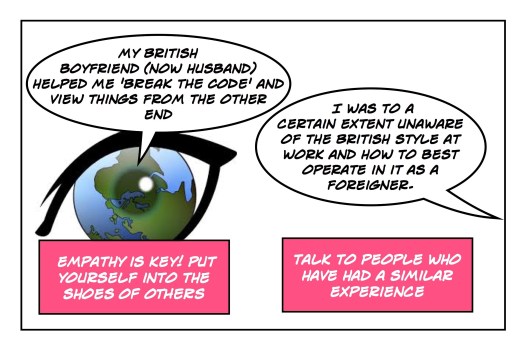
Tip 2 – Empathy and preparation – breaking the new code. Besides maintaining relationships with people from a cultural background similar to yours, it is important to make friends with people born in the new country. Among other things they may help you understand the perspective of ‘the other side’. Building empathy, know what I mean?
Page_2

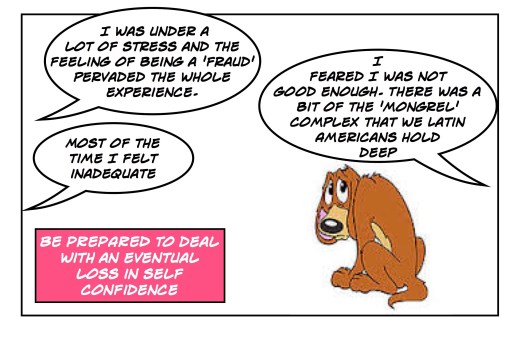
Tip 3 – Adjusting expectations and dealing with unexpected emotions – Beatriz tells us that in all her career, back in Brazil, her performance had always been assessed as above average. The feeling of not being ‘competent enough’ was a great surprise for her. It is important to be aware of this possibility and deal with these emotions openly.
Page_3.jpg

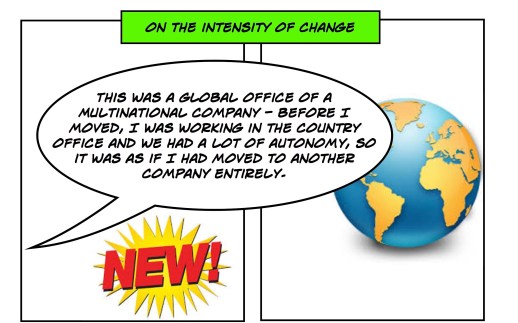
Tip 4 – About the intensity of the change – even if you don’t change companies, the organisational culture may be completely different from the one you were used to. It’s very important to understand the dynamics and position yourself appropriately in the new context.
Page_6

Tip 5 – The adaptation has to happen on both sides – I think there are two lessons here: 1. You may have to adapt to a new management style. That’s a fact. 2. For me, the key message here is for the organisations that send executives to live & work abroad. The preparation of leaders/managers that will host expats is fundamental. The right levels of ‘stress’ and ‘support’  must be found to ensure that all parts (organisation, manager and expat) benefit and grow with the experience.

Page_6

The experiences of the expats may be very different, depending on the organisation, country and the personal characteristics of the professional. Getting to know about and reflect upon experiences similar to ours is, almost always, a good investment of time and energy. I wish you a great week and do send me a note to know more about how a Transition Partner can help you (who is an expat) or your expat employees. I will be back next week!