
 Clique aqui para ler esse post em português
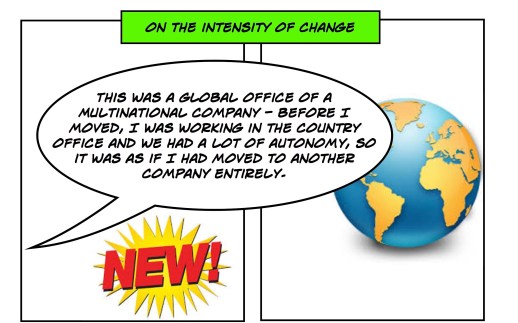
One of the reasons I left Brazil to work in London were the new guidelines defined by the Group CEO. He wanted representatives from the countries where the company operated working in the Head Office. What a great idea, isn’t it? Interviews were conducted and a few ‘foreigners’ were selected to join the central team. The principle, broadly accepted, was that a more diverse workforce would promote understanding of the various perspectives, increase integration of the global teams and, in turn, generate more profit to the business. It made sense to do it. Well, at least, in theory.

In practice, things happened to be a little bit more complex. Even though I was excited with the possibility of ‘exchanging views & sharing experiences’, I quickly noticed that ‘getting to know my culture‘ and benefiting from my ‘diverse perspective‘ were not things most people were particularly interested in. It was also surprising to see that some members of the local team nurtured stereotypical ideas about who I was and how I behaved. It was the first time in my life/career that I had to clarify things such as: “Yes, I am very punctual” or “No, I am not happy all the time and I definitely don’t dance Salsa!”.
There was a lot of talk about embracing global diversity in the Head Office, but as the organisational culture was predominantly local, the day-to-day attitudes frequently conflicted with the ‘talk’. There was a subtle pressure for standardisation. And the standard, of course, was the culture of the majority. The sooner the ‘different’ started to behave as ‘a local’ the better. It felt like an orchestra where everybody had to play the same instrument. With so many different ‘tunes‘ available, it felt like a complete waste. When getting updates on the initiative, the CEO would certainly see an increase in the percentage of ‘diverse people’ in the Head Office, but in practice, very little was changing.
As I was not yet known by the group, I was in a constant ‘battle’ to get people to pay attention to what I had to say. I knew my inputs were relevant so I concluded that the issue was of a different kind. After having my observations politely ignored whilst some other perspectives were applauded (even when they were less than coherent), I imagined that bias should be fuelling a kind of invisible ‘points system‘. It goes like this: when a person arrived in a meeting, the other participants would use their (conscious or unconscious) bias in relation to gender, cultural background, hierarchy etc. to award points. Depending on the amount of positive or negative ‘points’ granted to a person it would be more (or less) likely that s/he would get own inputs considered or accepted by the group. i.e. ideas coming from people with many negative points would be discarded in no time. As for me, it felt I was losing two points for being a woman and other two for being Latin American. At least I knew I had to fight four times harder to be heard! I shared the concept of the ‘points system’ with other expats and many of them reported having experienced something similar. One thing to mention is that the literature on unconscious/conscious gender bias is vast but not much have been written about cultural bias. My view is that this is a big area of opportunity.
On time (and with the help of a coach) I managed to understand and adapt to my new environment, created good relationships and felt more included. I definitely learned a lot. Later on I met amazing people who showed me that with good leadership bias can be managed and that merit and competence are the only criteria to ‘award points’ to professionals. It was also in this period that I started to get interested on cross-cultural relationships and the factors that contribute (or block) the adaptation of expatriates. Today I am convinced that the expat adaptation can be optimised with the previous preparation, not only of expats, but also of the local teams. Having open conversations about stereotypes and ‘unconscious bias’ is a good starting point. There are many initiatives addressing the issue nowadays and a good example is a course on Unconscious Bias recently delivered to Facebook employees. I found it very pragmatic, dynamic and informative, although with a lot more focus on gender bias. I recommend it to anyone interested on the topic. Here you go the link : https://managingbias.fb.com
And…if you want to know more about how the work with a Transition Partner can support the adaptation of expats, do get in touch.
Have a great week! See you next Tuesday.





 Anyone who has started a job in a new company, has been promoted to a role as a manager for the first time or, as it happened with me, has been assigned to work in a foreign country knows what I am talking about. When I was transferred from Brazil to London, ten years ago, training on ‘habits of English people’ was provided as part of my expat preparation. The issue was: I was ‘
 ‘
‘ Luciana Biscaia